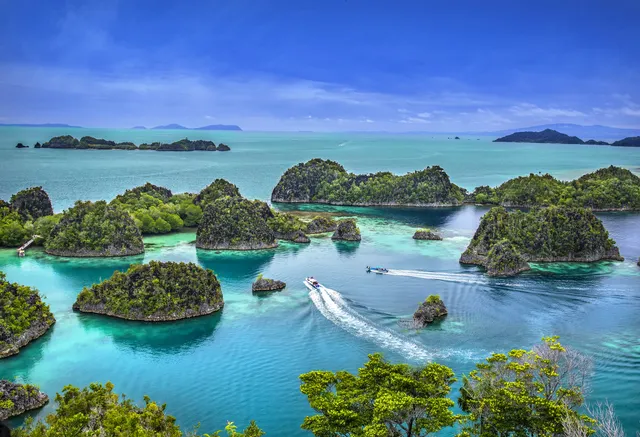
Indonesia is the world's largest archipelago (17,508 islands, 270 million people, eight time zones) and the experience most international visitors have of it is fourteen days in Bali. Bali is exceptional, and the best things about Bali extend well beyond Kuta and Ubud. But arriving in Bali and calling it Indonesia is like arriving in Santorini and calling it Europe.
The rest of the archipelago is accessible. It is, in many places, dramatically easier than it looks on a map. What it requires is accepting that the journey between islands is part of the experience rather than a logistical obstacle.
Java: The Cultural Core
Java is Indonesia's most populous island, 150 million people on an area the size of England, and the cultural centre of Indonesian civilisation, the seat of the Majapahit Empire, the Mataram Sultanate, the Dutch colonial administration, and the current Republic. It is also, to most international visitors flying through Bali, the island they see from the window and don't land on.
Yogyakarta (universally called Jogja) is Java's cultural capital: a Sultanate city of 400,000 that has maintained its royal court (the Keraton) in continuous operation since 1755, when it was established as the successor state to the fragmented Mataram kingdom. The Sultan of Yogyakarta is simultaneously the city's head of state and its elected governor, a constitutional arrangement unique in Indonesia. The Keraton is open to visitors through its outer pavilions during daylight hours; gamelan rehearsals occur in the forecourt on specific mornings.
Borobudur, forty kilometres northwest of Yogyakarta, is the largest Buddhist monument in the world: a 9th-century mandala built in stone on nine terraces, 2,672 relief panels, 504 Buddha statues, 72 stupas, all of it constructed without mortar. The UNESCO restoration completed in 1983 stabilised the structure; the dawn visit, arriving at the base before 5am to climb the terraces as the sun rises over the Menoreh Hills, has become the standard experience precisely because it works: the light at 6am on the upper terrace, the volcanoes emerging from the mist to the north, the temple empty except for the monks beginning morning prayers at the central stupa, is the Borobudur that the midday tour buses don't reach.
Prambanan, fifteen kilometres east of Yogyakarta, is the counterpart Hindu complex: a 9th-century ensemble of 240 temples, the central three dedicated to the Trimurti (Brahma, Vishnu, Shiva), damaged by earthquake in 2006 and partially restored. The restoration is ongoing and visible: some compounds are scaffolded, some are open, the gap between the 9th-century stonework and the modern restoration material is apparent and honest rather than hidden. The Ramayana ballet performed in the outdoor amphitheatre on full-moon nights, the Prambanan towers lit behind the stage, is one of the better cultural performances in Southeast Asia.
Mount Bromo, in East Java, is the caldera experience that Indonesia produces at a scale that Bali's Batur doesn't. The Tengger Caldera (a 10-kilometre volcanic crater containing five volcanic cones, the active Bromo venting sulphur and steam from its interior) is reached from the Bromo Tengger Semeru National Park at the caldera rim, then by jeep across the sand sea to the crater staircase, then on foot to the crater edge. The view of the sand sea from the Penanjakan viewpoint at dawn, the active cone venting against the Semeru summit behind it, is the photograph. The experience of walking to the crater edge and looking down into the active vent (the smell of sulphur, the steam, the sound of gas movement) is not substitutable by a photograph.
Lombok: The Island That Bali Was
Lombok sits immediately east of Bali, separated by the Wallace Line (the biogeographic boundary that separates Asian and Australian fauna) and, more practically, by a thirty-minute flight or two-and-a-half-hour fast boat. Its population is predominantly Sasak Muslim, its culture distinct from Bali's Hindu-Javanese traditions, its landscape organised around the summit of Rinjani, a 3,726-metre active volcano with a crater lake that is one of the most dramatic mountain environments in Southeast Asia.
The south coast of Lombok (Kuta Lombok (distinct from Bali's Kuta), Mawun, Selong Belanak, Tanjung Aan) is a series of horseshoe bays of extraordinary quality, the kind of beach that Thailand's Andaman coast once had before development normalised it. The road connecting these bays is partially paved, partially dirt track. The infrastructure is basic; the accommodation has improved substantially since 2018, when several boutique properties opened on the clifftop above Tanjung Aan. The water is clear. The bays face the Indian Ocean. The swell at Kuta Lombok during the dry season produces surfable waves without the crowds of Uluwatu.
Rinjani's summit trek (a three-day, two-night ascent to 3,726 metres and descent via the crater lake) requires a licensed guide and porter (mandatory in the national park), reasonable fitness, and the right season (April to November; the wet season closes the summit route). The view from the rim at dawn, the crater lake 600 metres below and the whole of Lombok and Bali visible in clear weather, is the standard pay-off for the exhaustion of the third day's ascent.
Flores: The Island Before Komodo
Flores (the name means flowers, the Portuguese name for the island they reached in the 16th century) is the western gateway to the Komodo National Park and has, as a result, developed a thin tourist infrastructure built around the Komodo diving and dragon-watching circuit. Beyond Labuan Bajo, Flores extends 380 kilometres east, largely unvisited.
Kelimutu National Park, near Ende in central Flores, contains three crater lakes whose colours change independently of each other: currently (and variably) turquoise, black, and russet-brown. The colour changes result from fluctuations in volcanic gas composition and mineral deposits in the lake chemistry; the lakes have been monitored since the 1960s and have changed colour multiple times. The sunrise at Kelimutu, watching the colours emerge from the mist as the light strengthens, is the experience. The last monitoring records showed the lakes at three distinct colours; they may have changed again by the time you visit.
Wae Rebo is a traditional Manggarai village in the highlands of central Flores, accessible only by a three-hour trek from the road head through mountain forest: there are no vehicles, no electricity except solar panels, no accommodation beyond the cone-shaped traditional mbaru niang houses where visitors sleep on bamboo platforms communally. The village receives perhaps 3,000 visitors per year, staying overnight. The evening meal cooked over the central hearth, the village council ceremony after dinner, and the pre-dawn fog lifting to reveal the mountain valley below are the experience: slow, deliberate, requiring actual arrival rather than passing through.
Sumatra: The Other Island
Sumatra is Indonesia's second-largest island and, with 58 million people, one of the world's most populous islands. Its tourism profile in international travel is minimal relative to its scale: most of the international interest concentrates on Bukit Lawang (orang-utan rehabilitation and trekking in the Gunung Leuser National Park) and Lake Toba, the world's largest volcanic lake, 100 kilometres long and 30 kilometres wide, filling a caldera left by an eruption 74,000 years ago large enough to have caused a global volcanic winter.
The Batak communities of the Toba highlands (the Toba Batak, Karo Batak, Simalungun, and others) maintain architectural and musical traditions that are among the most distinct in Indonesia. Samosir Island, in the centre of Lake Toba, is accessible by ferry and contains the main Batak village complex, stone tomb monuments, and the traditional carved houses whose forward-leaning rooflines are the visual signature of Batak architecture. The lake at dawn, mist lifting from water that is 450 metres deep, the volcanic caldera rim visible on all sides, is the image.